


A Whitepaper by Arhasi AI
Real-Time Reporting
Backed by Trust
The New Imperative for Enterprise Decision Intelligence
February 2026
Executive Summary
In today's business landscape, real-time decision-making separates winners from losers. Yet despite billions spent on data infrastructure and BI tools, most enterprises face a critical gap: they can't trust their insights enough to act on them immediately.This whitepaper explores why traditional BI fails to deliver both speed and trust, examines the technical and organizational barriers holding businesses back, and charts a path forward for enterprises ready to transform their decision-making capabilities.
Research Insights
Key Findings
Data-driven insights from enterprise analytics leaders
40%
Faster time-to-decision
Organizations with real-time, trustworthy reporting
25%
Improvement in strategic outcomes
When speed and trust converge
5-7
Business days lost monthly
Waiting for custom reports and dashboards
68%
Executives making decisions
Based on outdated or incomplete data

72%
Trust in data analytics remains the
primary barrier to AI adoption
with 72% of organizations citing data integrity concerns as their main hesitation
The Cost of Delay
Consider a typical enterprise reporting workflow: a business stakeholder identifies a question that requires data analysis. They submit a request to the analytics team. The request enters a queue. An analyst picks up the ticket, clarifies requirements through multiple email exchanges, writes SQL queries, builds visualizations, and finally delivers a dashboard—often days or weeks after the original request.
By the time the dashboard arrives, one of three things has happened: the business context has changed, the opportunity has passed, or the decision has already been made based on intuition rather than data. In each case, the organization has failed to capture the value of its data investments.
Time-to-Insight: Traditional vs. Modern Approaches
Average Time to Insight (Days)
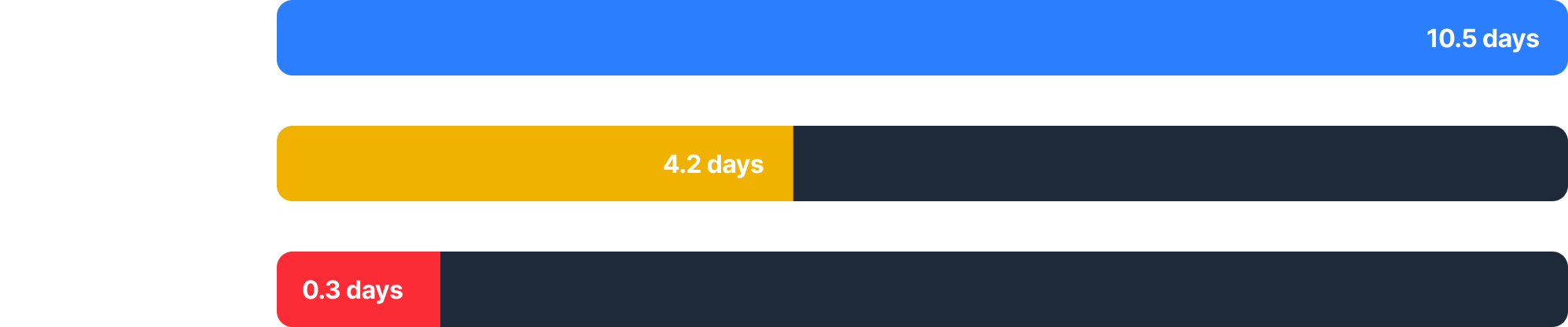

Organizations using AI-powered analytics achieve insights 35x faster than traditional BI approaches, enabling real-time decision-making.
The Trust Deficit
Speed without trust, however, is equally problematic. Organizations that have implemented self-service BI tools to accelerate reporting often discover a new challenge: inconsistent, unreliable, or incorrect insights that erode confidence in data-driven decision-making.

Metric inconsistency
Different tools or analysts calculating the same metric differently

Data lineage opacity
Inability to trace how a number was calculated or where it originated

Access control failures
Users seeing data they shouldn't, or making decisions based on incomplete views

Audit gaps
No record of who queried what data, when, or for what purpose
When executives cannot trust their data, they revert to instinct-based decision-making, negating billions in BI infrastructure investments. The trust deficit is not merely a technical problem—it's a strategic vulnerability.
Why Traditional BI Falls Short
Traditional BI platforms were built for a different world—static reports, manageable data, slow business cycles. Three core limitations now cripple their effectiveness in modern enterprises.

60-70%
of analyst time spent on repetitive tasks
The Technical Bottleneck
Most enterprise BI tools require significant technical expertise. Creating a new dashboard demands knowledge of data schemas, SQL syntax, join logic, and visualization best practices. Business users who understand the questions cannot build the reports, while technical users lack the business context to ask the right questions.

6-18
months for typical implementation
The Implementation Tax
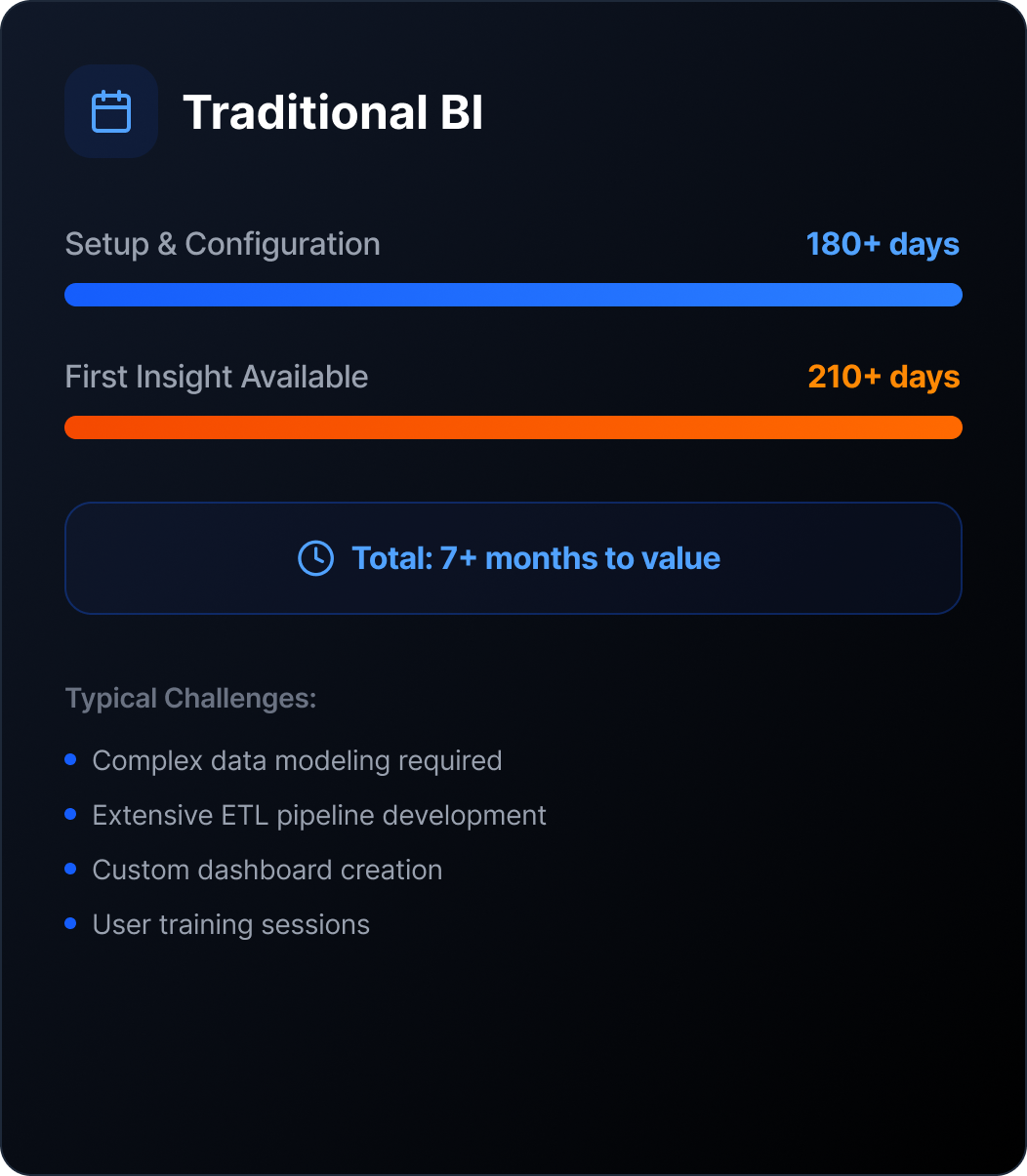
Traditional BI deployments carry heavy implementation costs. Data must be modeled, ETL pipelines constructed, semantic layers defined, and reports pre-built. A typical enterprise BI implementation requires 6-18 months and seven-figure investments before delivering the first production dashboard.

0
comprehensive audit trails
The Governance Gap
Traditional BI platforms often treat governance as an afterthought. When business users create ad-hoc reports, there's typically no mechanism to ensure they're using standardized metric definitions. One team calculates metrics one way, another team differently—all technically correct but strategically incompatible.
Traditional Approach
Traditional BI Workflow: The Bottleneck
Average time: 7-14 days

Business Question


Submit Ticket

Queue Wait
3-5 days

Analyst Assigns

Query Writing
2-7 days


Dashboard Build


Review

Delivery

Total: 7-14 days average
Modern AI Approach
AI-Powered Analytics Workflow: Real-Time Intelligence
Average time: Minutes or less

Business Question
Instant


AI Processes
Milliseconds

Auto-Visualization
Seconds

Instant Delivery
Complete

Total: Minutes or less
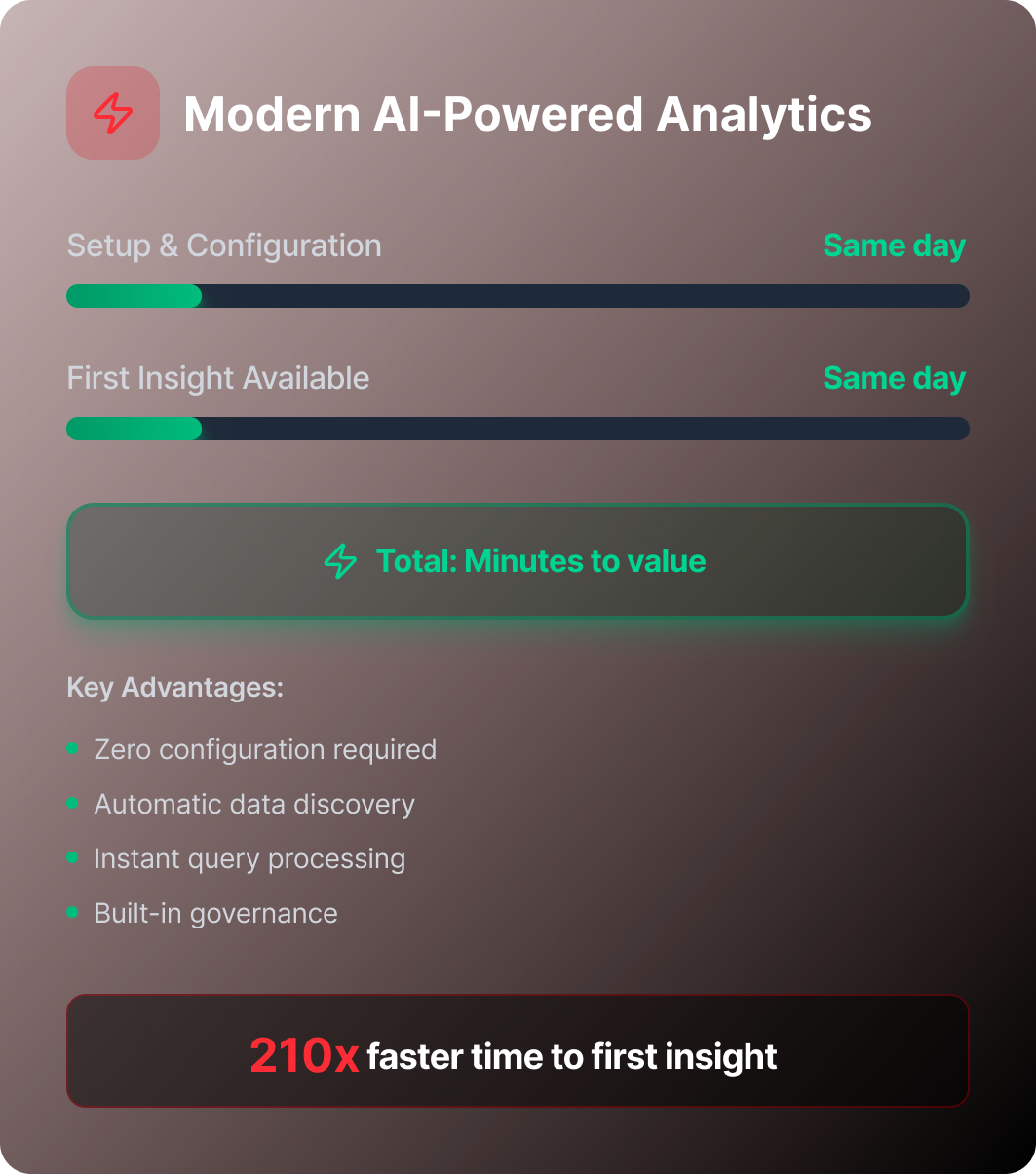
35x faster than traditional workflows
Time to Value
Implementation Timeline Comparison
The Path Forward: AI-Powered, Trust-First Analytics
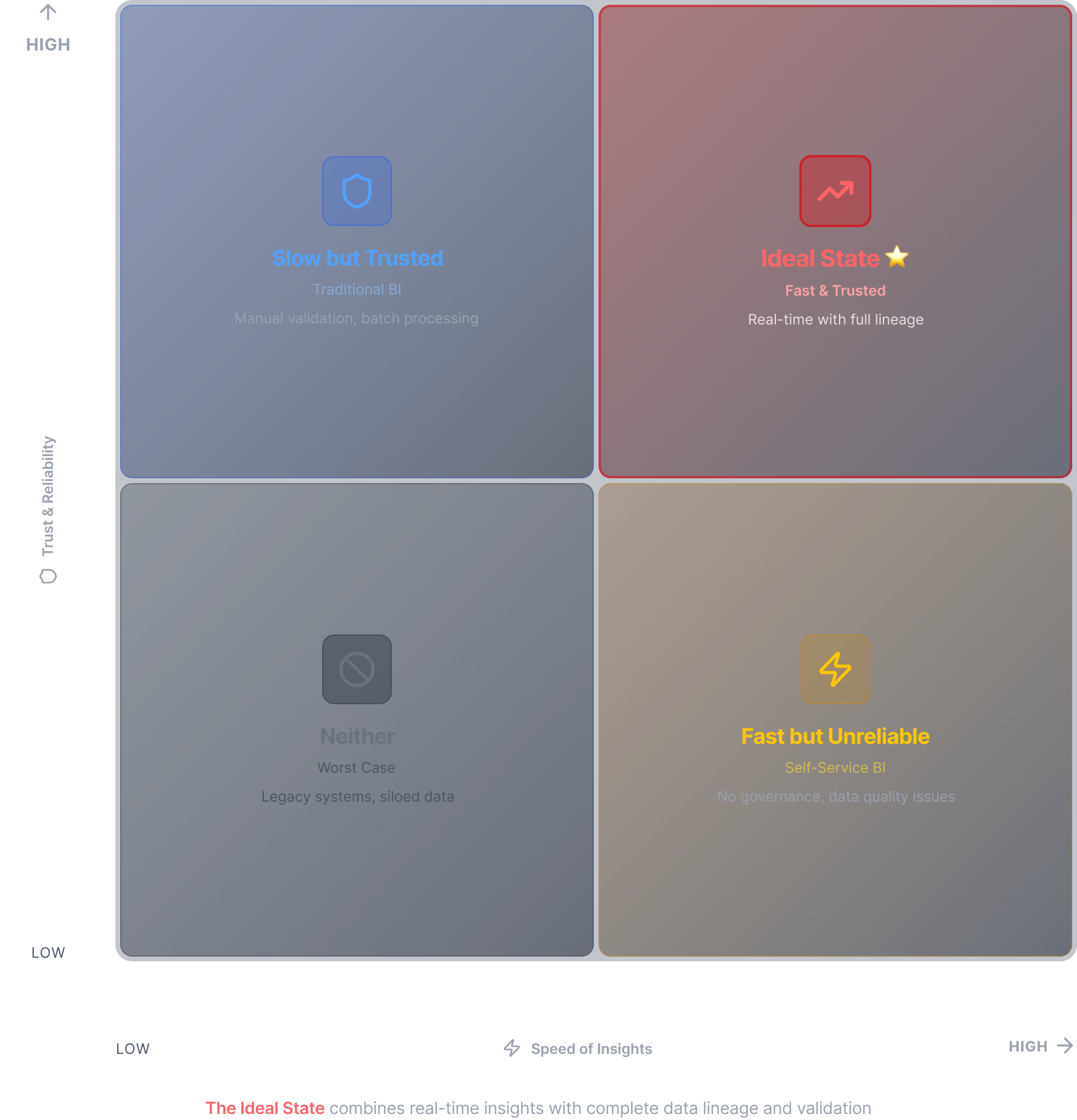
Solving the speed-trust paradox demands a fundamental rethink of enterprise BI. Next-generation platforms don't force you to choose, they deliver both through three core capabilities.
Three Pillars of Modern Analytics

Real-Time Insights
Natural Language Interface
Plain English queries
No SQL required
Context-aware responses
Auto-optimization

Complete Trust
Governance First
Role-based access
Metric standardization
Complete audit trails
Source traceability

Instant Analytics
Zero-Config Deployment
Auto data discovery
Minutes to value
No pre-modeling
Plug-and-play
Built on AI & Machine Learning Foundation
40%
Faster Decisions
25%
Better Outcomes
60%
Cost Reduction
About Arhasi AI
Arhasi AI is pioneering the next generation of enterprise AI platforms with a focus on integrity, trust, and responsible deployment. [Add a button to direct to about us section
About Us

Experience Real-Time AnalyticsBuilt on Trust
To see how modern analytics platforms can deliver both speed and trust in your organization, we invite you to explore solutions that demonstrate these principles in action.
Contact Information

contactus@arhasi.com
|
www.arhasi.ai
contactus@arhasi.com
|
www.arhasi.ai


© 2026 Arhasi Inc. All rights reserved.
A Whitepaper by Arhasi AI
Real-Time Reporting
Backed by Trust
The New Imperative for Enterprise Decision Intelligence
February 2026
Executive Summary
In today's business landscape, real-time decision-making separates winners from losers. Yet despite billions spent on data infrastructure and BI tools, most enterprises face a critical gap: they can't trust their insights enough to act on them immediately.This whitepaper explores why traditional BI fails to deliver both speed and trust, examines the technical and organizational barriers holding businesses back, and charts a path forward for enterprises ready to transform their decision-making capabilities.
Research Insights
Key Findings
Data-driven insights from enterprise analytics leaders
40%
Faster time-to-decision
Organizations with real-time, trustworthy reporting
25%
Improvement in strategic outcomes
When speed and trust converge
5-7
Business days lost monthly
Waiting for custom reports and dashboards
68%
Executives making decisions
Based on outdated or incomplete data
72%
Trust in data analytics remains the
primary barrier to AI adoption
with 72% of organizations citing data integrity concerns as their main hesitation
The Cost of Delay
Consider a typical enterprise reporting workflow: a business stakeholder identifies a question that requires data analysis. They submit a request to the analytics team. The request enters a queue. An analyst picks up the ticket, clarifies requirements through multiple email exchanges, writes SQL queries, builds visualizations, and finally delivers a dashboard—often days or weeks after the original request.
By the time the dashboard arrives, one of three things has happened: the business context has changed, the opportunity has passed, or the decision has already been made based on intuition rather than data. In each case, the organization has failed to capture the value of its data investments.
Time-to-Insight: Traditional vs. Modern Approaches
Average Time to Insight (Days)
Organizations using AI-powered analytics achieve insights 35x faster than traditional BI approaches, enabling real-time decision-making.
The Trust Deficit
Speed without trust, however, is equally problematic. Organizations that have implemented self-service BI tools to accelerate reporting often discover a new challenge: inconsistent, unreliable, or incorrect insights that erode confidence in data-driven decision-making.
Metric inconsistency
Different tools or analysts calculating the same metric differently
Data lineage opacity
Inability to trace how a number was calculated or where it originated
Access control failures
Users seeing data they shouldn't, or making decisions based on incomplete views
Audit gaps
No record of who queried what data, when, or for what purpose
When executives cannot trust their data, they revert to instinct-based decision-making, negating billions in BI infrastructure investments. The trust deficit is not merely a technical problem—it's a strategic vulnerability.
Why Traditional BI Falls Short
Traditional BI platforms were built for a different world—static reports, manageable data, slow business cycles. Three core limitations now cripple their effectiveness in modern enterprises.
60-70%
of analyst time spent on repetitive tasks
The Technical Bottleneck
Most enterprise BI tools require significant technical expertise. Creating a new dashboard demands knowledge of data schemas, SQL syntax, join logic, and visualization best practices. Business users who understand the questions cannot build the reports, while technical users lack the business context to ask the right questions.
6-18
months for typical implementation
The Implementation Tax
Traditional BI deployments carry heavy implementation costs. Data must be modeled, ETL pipelines constructed, semantic layers defined, and reports pre-built. A typical enterprise BI implementation requires 6-18 months and seven-figure investments before delivering the first production dashboard.
0
comprehensive audit trails
The Governance Gap
Traditional BI platforms often treat governance as an afterthought. When business users create ad-hoc reports, there's typically no mechanism to ensure they're using standardized metric definitions. One team calculates metrics one way, another team differently—all technically correct but strategically incompatible.
Traditional Approach
Traditional BI Workflow: The Bottleneck
Average time: 7-14 days
Business Question

Submit Ticket
Queue Wait
3-5 days

Analyst Assigns
Query Writing
2-7 days
Dashboard Build

Review
Delivery
Total: 7-14 days average
Modern AI Approach
AI-Powered Analytics Workflow: Real-Time Intelligence
Average time: Minutes or less
Business Question
Instant
AI Processes
Milliseconds
Auto-Visualization
Seconds
Instant Delivery
Complete
Total: Minutes or less
35x faster than traditional workflows
Time to Value
Implementation Timeline Comparison
The Path Forward: AI-Powered, Trust-First Analytics
Solving the speed-trust paradox demands a fundamental rethink of enterprise BI. Next-generation platforms don't force you to choose, they deliver both through three core capabilities.
Three Pillars of Modern Analytics
Real-Time Insights
Natural Language Interface
Plain English queries
No SQL required
Context-aware responses
Auto-optimization
Complete Trust
Governance First
Role-based access
Metric standardization
Complete audit trails
Source traceability
Instant Analytics
Zero-Config Deployment
Auto data discovery
Minutes to value
No pre-modeling
Plug-and-play
Built on AI & Machine Learning Foundation
40%
Faster Decisions
25%
Better Outcomes
60%
Cost Reduction
About Arhasi AI
Arhasi AI is pioneering the next generation of enterprise AI platforms with a focus on integrity, trust, and responsible deployment. [Add a button to direct to about us section
About Us
Experience Real-Time AnalyticsBuilt on Trust
To see how modern analytics platforms can deliver both speed and trust in your organization, we invite you to explore solutions that demonstrate these principles in action.
Contact Information
contactus@arhasi.com
|
www.arhasi.ai
© 2026 Arhasi Inc. All rights reserved.
A Whitepaper by Arhasi AI
Real-Time Reporting
Backed by Trust
The New Imperative for Enterprise Decision Intelligence
February 2026
Executive Summary
In today's business landscape, real-time decision-making separates winners from losers. Yet despite billions spent on data infrastructure and BI tools, most enterprises face a critical gap: they can't trust their insights enough to act on them immediately.This whitepaper explores why traditional BI fails to deliver both speed and trust, examines the technical and organizational barriers holding businesses back, and charts a path forward for enterprises ready to transform their decision-making capabilities.
Research Insights
Key Findings
Data-driven insights from enterprise analytics leaders
40%
Faster time-to-decision
Organizations with real-time, trustworthy reporting
25%
Improvement in strategic outcomes
When speed and trust converge
5-7
Business days lost monthly
Waiting for custom reports and dashboards
68%
Executives making decisions
Based on outdated or incomplete data
72%
Trust in data analytics remains the
primary barrier to AI adoption
with 72% of organizations citing data integrity concerns as their main hesitation
The Cost of Delay
Consider a typical enterprise reporting workflow: a business stakeholder identifies a question that requires data analysis. They submit a request to the analytics team. The request enters a queue. An analyst picks up the ticket, clarifies requirements through multiple email exchanges, writes SQL queries, builds visualizations, and finally delivers a dashboard—often days or weeks after the original request.
By the time the dashboard arrives, one of three things has happened: the business context has changed, the opportunity has passed, or the decision has already been made based on intuition rather than data. In each case, the organization has failed to capture the value of its data investments.
Time-to-Insight: Traditional vs. Modern Approaches
Average Time to Insight (Days)
Organizations using AI-powered analytics achieve insights 35x faster than traditional BI approaches, enabling real-time decision-making.
The Trust Deficit
Speed without trust, however, is equally problematic. Organizations that have implemented self-service BI tools to accelerate reporting often discover a new challenge: inconsistent, unreliable, or incorrect insights that erode confidence in data-driven decision-making.
Metric inconsistency
Different tools or analysts calculating the same metric differently
Data lineage opacity
Inability to trace how a number was calculated or where it originated
Access control failures
Users seeing data they shouldn't, or making decisions based on incomplete views
Audit gaps
No record of who queried what data, when, or for what purpose
When executives cannot trust their data, they revert to instinct-based decision-making, negating billions in BI infrastructure investments. The trust deficit is not merely a technical problem—it's a strategic vulnerability.
Why Traditional BI Falls Short
Traditional BI platforms were built for a different world—static reports, manageable data, slow business cycles. Three core limitations now cripple their effectiveness in modern enterprises.
60-70%
of analyst time spent on repetitive tasks
The Technical Bottleneck
Most enterprise BI tools require significant technical expertise. Creating a new dashboard demands knowledge of data schemas, SQL syntax, join logic, and visualization best practices. Business users who understand the questions cannot build the reports, while technical users lack the business context to ask the right questions.
6-18
months for typical implementation
The Implementation Tax
Traditional BI deployments carry heavy implementation costs. Data must be modeled, ETL pipelines constructed, semantic layers defined, and reports pre-built. A typical enterprise BI implementation requires 6-18 months and seven-figure investments before delivering the first production dashboard.

0
comprehensive audit trails
The Governance Gap
Traditional BI platforms often treat governance as an afterthought. When business users create ad-hoc reports, there's typically no mechanism to ensure they're using standardized metric definitions. One team calculates metrics one way, another team differently—all technically correct but strategically incompatible.
Traditional Approach
Traditional BI Workflow: The Bottleneck
Average time: 7-14 days
Business Question

Submit Ticket
Queue Wait
3-5 days
Analyst Assigns
Query Writing
2-7 days
Dashboard Build

Review

Delivery
Total: 7-14 days average
Modern AI Approach
AI-Powered Analytics Workflow: Real-Time Intelligence
Average time: Minutes or less
Business Question
Instant

AI Processes
Milliseconds
Auto-Visualization
Seconds
Instant Delivery
Complete
Total: Minutes or less
35x faster than traditional workflows
Time to Value
Implementation Timeline Comparison
The Path Forward: AI-Powered, Trust-First Analytics
Solving the speed-trust paradox demands a fundamental rethink of enterprise BI. Next-generation platforms don't force you to choose, they deliver both through three core capabilities.
Three Pillars of Modern Analytics
Real-Time Insights
Natural Language Interface
Plain English queries
No SQL required
Context-aware responses
Auto-optimization
Complete Trust
Governance First
Role-based access
Metric standardization
Complete audit trails
Source traceability
Instant Analytics
Zero-Config Deployment
Auto data discovery
Minutes to value
No pre-modeling
Plug-and-play
Built on AI & Machine Learning Foundation
40%
Faster Decisions
25%
Better Outcomes
60%
Cost Reduction
About Arhasi AI
Arhasi AI is pioneering the next generation of enterprise AI platforms with a focus on integrity, trust, and responsible deployment. [Add a button to direct to about us section
About Us
Experience Real-Time AnalyticsBuilt on Trust
To see how modern analytics platforms can deliver both speed and trust in your organization, we invite you to explore solutions that demonstrate these principles in action.
Contact Information
contactus@arhasi.com
|
www.arhasi.ai
contactus@arhasi.com
|
www.arhasi.ai
© 2026 Arhasi Inc. All rights reserved.