

Whitepaper, March 2026
Guardrails Stop Mistakes. Trust Infrastructure Prevents Them.
The Enterprise Case for AI Trust Infrastructure
As enterprises accelerate AI adoption in regulated, high-stakes environments, a critical assumption has been that deploying guardrails is the same as trusting AI. It is not.
Chief Risk Officers
Compliance Leaders
Technology Executives
01
The World Has Changed
AI Is Everywhere. Trust Is Not.
Enterprises aren't just experimenting with AI, they're trusting it to deny loans, approve claims, route customers, flag fraud, and automate decisions that affect real people at scale.
83%
of AI failures are decision failures, not output violations
1 in 4
regulated AI deployments face audit readiness gaps
0%
of guardrail vendors provide full decision lineage
"The question is no longer whether your AI behaved. The question is whether it was allowed to decide, and whether you can prove it."
02
The Guardrail Illusion
Guardrails Moderate Behavior.
They Don't Make Decisions Trustworthy.
Guardrails are valuable tools. They prevent harmful outputs, enforce content policies, and constrain model behavior at the interaction layer. But guardrails are structurally incomplete, they operate at the surface, inspecting messages, filtering outputs, applying rules. They are stateless, session-scoped, and interaction-bound.

Real Scenario: Financial Services
Case Study
An AI lending system denies a loan application. The output is clean: no toxic language, no policy violation. Guardrails pass it through without a flag. But the denial was driven by training data with historical bias. Input features came from stale CRM records. The model version was never validated for this product line. No guardrail in the world would have caught any of this.
03
The Real Risk Stack
Enterprise AI Carries 6 Distinct Risk Categories
✓ Covered
Output Risk
AI says something harmful, off-policy, or toxic
✗ Not Covered

Model Risk
Wrong model version used; out-of-scope application
✗ Not Covered

Data Risk
Stale, biased, or corrupted inputs drive decisions
✗ Not Covered

Decision Risk
Legally permissible but factually wrong or unfair
✗ Not Covered

Context Risk
Agent uses poisoned context or wrong retrieval

✗ Not Covered
Governance Risk
Cannot prove authority, policy, or
legitimacy
04
Three Lines of Defense
Guardrails Live in the First Line.
Enterprise AI Risk Doesn't.

1st Line

Guardrails Gap
Local controls only. No traceability or systemic integrity.

Trust Infrastructure
Decision context tracking. Agent authority governance. Failure diagnostics.

2nd Line
Guardrails Gap
Cannot answer: which model? Which data? Was it approved?
Trust Infrastructure
Decision provenance. Model lineage. Policy application audit trail.

3rd Line
Guardrails Gap
No evidence chain. Cannot reconstruct decisions under scrutiny.
Trust Infrastructure
Forensic-grade decision reconstruction. Audit-ready lineage artifacts.
05
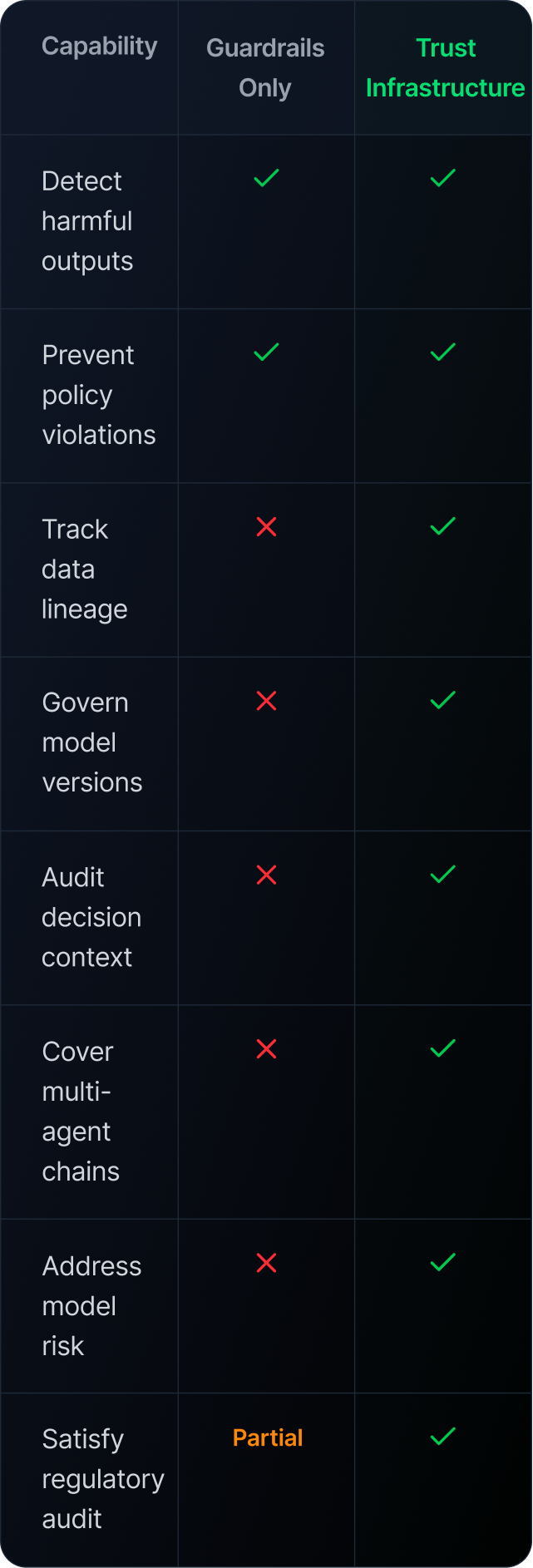
Capability Comparison
What Trust Infrastructure Adds
06
The Trust Imperative
5 Questions Every Regulated Enterprise Should Be Asking
01
Can you trace every AI decision back to its data source, model version, and policy?
02
If a regulator requests audit evidence for an AI-driven outcome from 90 days ago, can you reconstruct it?
03
Do your second-line risk and compliance teams have real visibility into how AI decisions are made?
04
When an AI agent calls a tool, queries a database, or triggers a workflow, who authorized that action?
05
If your AI system produces a discriminatory or erroneous decision, can you determine root cause within hours?
AI Trust Is Entering Its Next Phase
Phase 1
Behavior Control
Guardrails
Filters
Output Safety

Phase 2
Decision Trust
Lineage
Data Quality
Defensibility
"Guardrails tell you the AI behaved. Trust infrastructure tells you the AI was right to act. In regulated industries, only one of those answers satisfies an auditor."
Explore AI Trust Infrastructure
Learn how Arhasi's Integrity-First AI can help your enterprise
Get Started

Whitepaper, March 2026
Guardrails Stop Mistakes. Trust Infrastructure Prevents Them.
The Enterprise Case for AI Trust Infrastructure
As enterprises accelerate AI adoption in regulated, high-stakes environments, a critical assumption has been that deploying guardrails is the same as trusting AI. It is not.
Chief Risk Officers
Compliance Leaders
Technology Executives
01
The World Has Changed
AI Is Everywhere. Trust Is Not.
Enterprises aren't just experimenting with AI, they're trusting it to deny loans, approve claims, route customers, flag fraud, and automate decisions that affect real people at scale.
83%
of AI failures are decision failures, not output violations
1 in 4
regulated AI deployments face audit readiness gaps
0%
of guardrail vendors provide full decision lineage
"The question is no longer whether your AI behaved. The question is whether it was allowed to decide, and whether you can prove it."
02
The Guardrail Illusion
Guardrails Moderate Behavior.
They Don't Make Decisions Trustworthy.
Guardrails are valuable tools. They prevent harmful outputs, enforce content policies, and constrain model behavior at the interaction layer. But guardrails are structurally incomplete, they operate at the surface, inspecting messages, filtering outputs, applying rules. They are stateless, session-scoped, and interaction-bound.
Real Scenario: Financial Services
Case Study
An AI lending system denies a loan application. The output is clean: no toxic language, no policy violation. Guardrails pass it through without a flag. But the denial was driven by training data with historical bias. Input features came from stale CRM records. The model version was never validated for this product line. No guardrail in the world would have caught any of this.
03
The Real Risk Stack
Enterprise AI Carries 6 Distinct Risk Categories
✓ Covered
Output Risk
AI says something harmful, off-policy, or toxic
✗ Not Covered
Model Risk
Wrong model version used; out-of-scope application
✗ Not Covered
Data Risk
Stale, biased, or corrupted inputs drive decisions
✗ Not Covered
Decision Risk
Legally permissible but factually wrong or unfair
✗ Not Covered
Context Risk
Agent uses poisoned context or wrong retrieval
✗ Not Covered
Governance Risk
Cannot prove authority, policy, or
legitimacy
04
Three Lines of Defense
Guardrails Live in the First Line.
Enterprise AI Risk Doesn't.

1st Line

Guardrails Gap
Local controls only. No traceability or systemic integrity.

Trust Infrastructure
Decision context tracking. Agent authority trust. Failure diagnostics.

2nd Line

Guardrails Gap
Cannot answer: which model? Which data? Was it approved?

Trust Infrastructure
Decision provenance. Model lineage. Policy application audit trail.

3rd Line
Guardrails Gap
No evidence chain. Cannot reconstruct decisions under scrutiny.
Trust Infrastructure
Forensic-grade decision reconstruction. Audit-ready lineage artifacts.
05
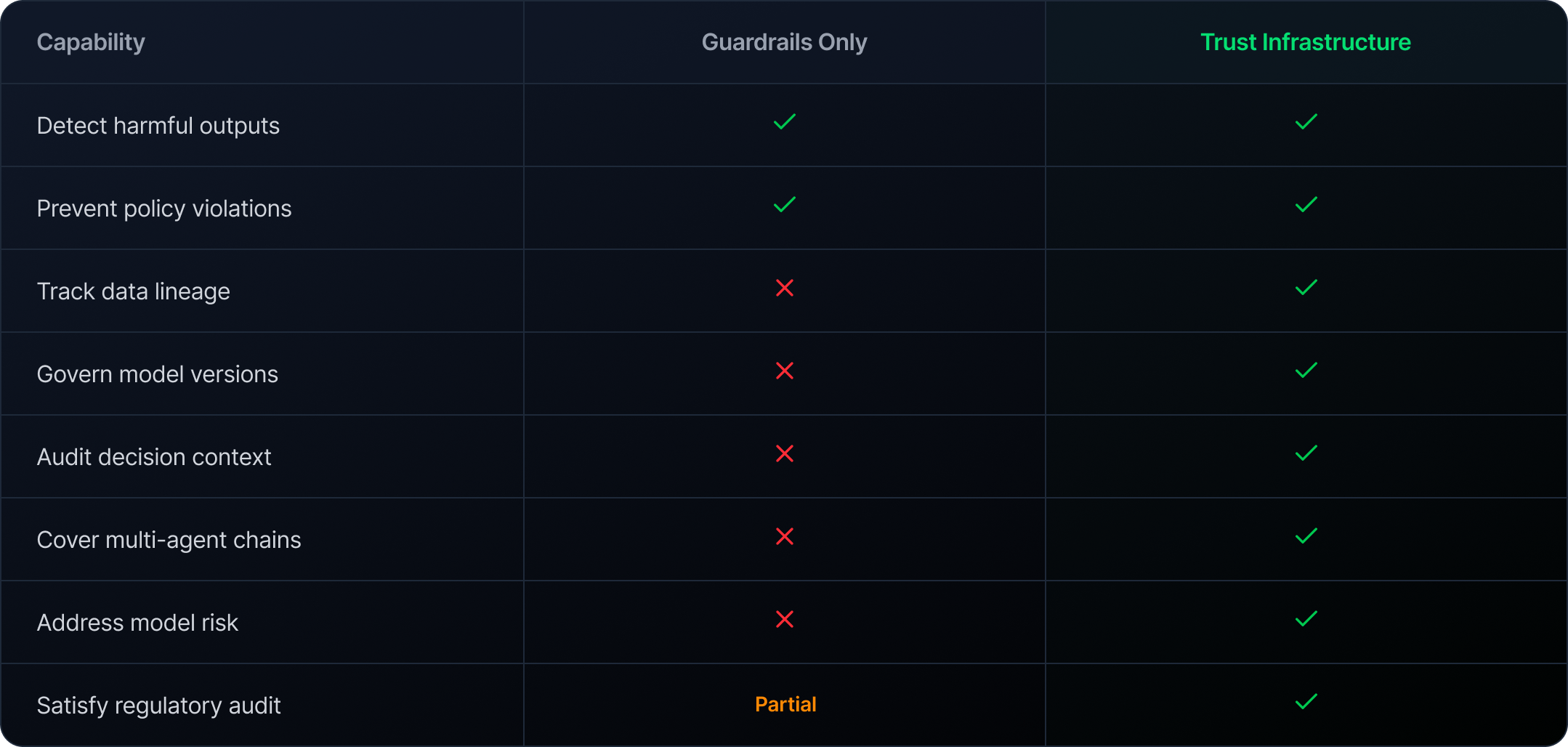
Capability Comparison
What Trust Infrastructure Adds
06
The Trust Imperative
5 Questions Every Regulated Enterprise Should Be Asking
01
Can you trace every AI decision back to its data source, model version, and policy?
02
If a regulator requests audit evidence for an AI-driven outcome from 90 days ago, can you reconstruct it?
03
Do your second-line risk and compliance teams have real visibility into how AI decisions are made?
04
When an AI agent calls a tool, queries a database, or triggers a workflow, who authorized that action?
05
If your AI system produces a discriminatory or erroneous decision, can you determine root cause within hours?
AI Trust Is Entering Its Next Phase
Phase 1
Behavior Control
Guardrails
Filters
Output Safety
Phase 2
Decision Trust
Lineage
Data Quality
Defensibility
"Guardrails tell you the AI behaved. Trust infrastructure tells you the AI was right to act. In regulated industries, only one of those answers satisfies an auditor."
Explore AI Trust Infrastructure
Learn how Arhasi's Integrity-First AI can help your enterprise
Get Started
Whitepaper, March 2026
Guardrails Stop Mistakes. Trust Infrastructure Prevents Them.
The Enterprise Case for AI Trust Infrastructure
As enterprises accelerate AI adoption in regulated, high-stakes environments, a critical assumption has been that deploying guardrails is the same as trusting AI. It is not.
Chief Risk Officers
Compliance Leaders
Technology Executives
01
The World Has Changed
AI Is Everywhere. Trust Is Not.
Enterprises aren't just experimenting with AI, they're trusting it to deny loans, approve claims, route customers, flag fraud, and automate decisions that affect real people at scale.
83%
of AI failures are decision failures, not output violations
1 in 4
regulated AI deployments face audit readiness gaps
0%
of guardrail vendors provide full decision lineage
"The question is no longer whether your AI behaved. The question is whether it was allowed to decide, and whether you can prove it."
02
The Guardrail Illusion
Guardrails Moderate Behavior.
They Don't Make Decisions Trustworthy.
Guardrails are valuable tools. They prevent harmful outputs, enforce content policies, and constrain model behavior at the interaction layer. But guardrails are structurally incomplete, they operate at the surface, inspecting messages, filtering outputs, applying rules. They are stateless, session-scoped, and interaction-bound.
Real Scenario: Financial Services
Case Study
An AI lending system denies a loan application. The output is clean: no toxic language, no policy violation. Guardrails pass it through without a flag. But the denial was driven by training data with historical bias. Input features came from stale CRM records. The model version was never validated for this product line. No guardrail in the world would have caught any of this.
03
The Real Risk Stack
Enterprise AI Carries 6 Distinct Risk Categories
✓ Covered
Output Risk
AI says something harmful, off-policy, or toxic
✗ Not Covered
Model Risk
Wrong model version used; out-of-scope application
✗ Not Covered
Data Risk
Stale, biased, or corrupted inputs drive decisions
✗ Not Covered
Decision Risk
Legally permissible but factually wrong or unfair
✗ Not Covered
Context Risk
Agent uses poisoned context or wrong retrieval
✗ Not Covered
Governance Risk
Cannot prove authority, policy, or
legitimacy
04
Three Lines of Defense
Guardrails Live in the First Line.
Enterprise AI Risk Doesn't.
1st Line
Guardrails Gap
Local controls only. No traceability or systemic integrity.
Trust Infrastructure
Decision context tracking. Agent authority trust. Failure diagnostics.
2nd Line
Guardrails Gap
Cannot answer: which model? Which data? Was it approved?
Trust Infrastructure
Decision provenance. Model lineage. Policy application audit trail.
3rd Line
Guardrails Gap
No evidence chain. Cannot reconstruct decisions under scrutiny.
Trust Infrastructure
Forensic-grade decision reconstruction. Audit-ready lineage artifacts.
05
Capability Comparison
What Trust Infrastructure Adds
06
The Trust Imperative
5 Questions Every Regulated Enterprise Should Be Asking
01
Can you trace every AI decision back to its data source, model version, and policy?
02
If a regulator requests audit evidence for an AI-driven outcome from 90 days ago, can you reconstruct it?
03
Do your second-line risk and compliance teams have real visibility into how AI decisions are made?
04
When an AI agent calls a tool, queries a database, or triggers a workflow, who authorized that action?
05
If your AI system produces a discriminatory or erroneous decision, can you determine root cause within hours?
AI Trust Is Entering Its Next Phase
Phase 1
Behavior Control
Guardrails
Filters
Output Safety

Phase 2
Decision Trust
Lineage
Data Quality
Defensibility
"Guardrails tell you the AI behaved. Trust infrastructure tells you the AI was right to act. In regulated industries, only one of those answers satisfies an auditor."
Explore AI Trust Infrastructure
Learn how Arhasi's Integrity-First AI can help your enterprise
Get Started